
The Cabinet on Wednesday gave in-principle approval for strategic disinvestment along with transfer of management control in IDBI Bank in line with the Budget announcement earlier this year. The central government and LIC together own more than 94 per cent equity of IDBI Bank. LIC, currently the promoter of IDBI Bank with management control, has a 49.21 per cent stake. The Cabinet Committee on Economic Affairs chaired by Prime Minister Narendra Modi approved the strategic sale of IDBI Bank, an official statement said on Wednesday.

RBI's draft guidelines prescribe that banks with a strong capital base and NPAs below 3% can become brokers.

Rating agency Care Ratings said the gross non-performing assets ratio of domestic banks will increase to 4.5 per cent by March 2014 and impact the profitability by up to 30 per cent.

The need to allow government shareholding in public sector banks to come down below 51 per cent

The country's largest lender SBI on Saturday reported a 9.13 per cent rise in consolidated net profit to Rs 16,099.58 crore for the September quarter, weighed down by money it had to set aside for employees' impending wage and pension revisions. On a standalone basis, the State Bank of India (SBI) had a 8.03 per cent increase in the profit after tax for the reporting quarter at Rs 14,330 crore. However, the same was down 15.13 per cent compared to Rs 16,884 crore in the June quarter.

The financial sector has been deeply troubled since 2013. It is now in a full-blown crisis, warns Devangshu Datta.

The central government is on track to meet its fiscal deficit target of 6.4 per cent of the GDP for 2022-23 on the back of strong growth in revenue collections, the World Bank said in its India Development Update on Tuesday. High nominal GDP growth in the first quarter supported strong growth in revenue collection, especially Goods and Services Tax (GST), despite tax cuts on fuel. Notwithstanding an increase in spending due to expanded fertilizer subsidies and food subsidies for vulnerable households in response to the commodity price shock, the government is on track to meet its FY22/23 fiscal deficit target of 6.4 per cent of GDP and the general government deficit is projected to decline to 9.6 per cent from 10.3 per cent in FY21/22 and 13.3 per cent in FY20/21.

On November 12, 2021, the Reserve Bank of India (RBI) decided to ring in uniformity in asset classification and income recognition across all lending institutions. Shadow banks, or non-banking financial companies (NBFCs), like commercial banks, are to test non-performing assets (NPAs) on a daily basis and upgrade them to "standard assets" only when interest and principal arrears are settled by borrowers. This is going to create all manner of headaches for shadow banks and their clientele. Says Y S Chakravarti, managing director and chief executive officer (CEO), Shriram City Union Finance: "NPA levels will go up, especially of small borrowers.

Given Indian corporates's high indebtedness, new credit will be used for servicing loans rather than building factories. This is setting us up for more companies on life support and more zombie banks, warns Rahul Jacob.

RBL Bank is no Yes Bank. It's not fraught with fraud. It's a story of limitless ambition and greed for growth under a leader who doesn't want to give up, says Tamal Bandyopadhyay.

'Pockets of mid and small-cap indices are showing exuberance and are discounting even FY23 valuations now.'

Enjoying the backing of the regulator, Gill has identified the core problems, ring-fenced the banks from "influencers" and is in the process of building a new team. Now, he needs to play a Vikram Pandit for YES Bank, says Tamal Bandyopadhyay.

The Reserve Bank of India (RBI) on Thursday paved the way for niche banking by issuing draft guidelines for setting up payment banks and small banks.
Bank of Baroda has relatively better position on impaired assets.

Fintechs need to behave with responsibility and transparency. A lot of mis-selling has been happening. Other issues have been plaguing the fledgling industry -- high interest rates, even higher processing fees, harsh collection process and, most critically, data leakage leading to rampant frauds, points out Tamal Bandyopadhyay.

The government is somehow convinced that selective low-rate lending will stimulate demand and accelerate economic growth that plunged to a four-year low of 4.4 per cent in the first three months of 2013-14.
While IDBI Bank's 140 million customers and 1800-odd branches will come in handy for LIC to hawk insurance, the bank can use LIC's massive agent network to sell its retail loans. But if it is run the same way it had been in the past and LIC is a proxy of the government, then it has no future, says Tamal Bandyopadhyay.

Most players will need to burn the midnight oil to meet the deadline for creating a bank as well as specific norms set by RBI.
'Quality of management, corporate governance, allocation of capital, full disclosures should form the basis to decide investing in a particular stock.'

Is the worst over for Indian banks? The past two years saw them ride on treasury trades as deposits soared and credit growth dipped sharply. Gross and net non-performing assets (NPAs) moved south, and the provision coverage ratio (PCR), capital buffers, and profitability indicators are back at pre-pandemic levels. So, what's the plot ahead?

If credit card delinquency spells trouble, there may be questions with regard to the much bigger retail sub-categories of car and housing loans, notes T N Ninan.

Is the SBI chairman leaving the bank in a stronger and better position than what it was? Abhijit Lele finds out.

Norms governing investments by provident funds bar these from depositing funds in a commercial bank in case the NPAs of that bank exceed two per cent of net advances.
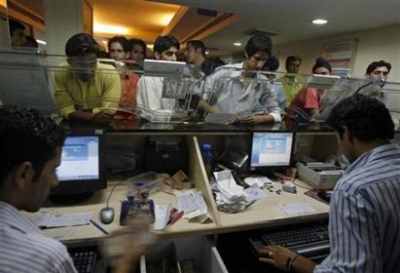
Criterion for corporates will effectively rule out entry for business houses.

The hit to economic activity will be mostly confined to the first quarter. And a third wave, if it materialises, is unlikely to be hugely disruptive for the economy, predicts T T Ram Mohan.

'The approach towards Mallya is not right because his unit could have been turned around earlier with additional funds from his side and the bank's side.'

Banks are in need of government support to manage the stressed assets

The country's largest lender SBI on Thursday reported a 4.20 per cent decline in consolidated December quarter net at Rs 6,257.55 crore, largely because of a higher base in the year-ago period where it had benefitted from a Rs 4,500 crore one-off income. On a standalone basis, the city-headquartered lender's net profit came in at Rs 5,196.22 crore as against Rs 5,583.36 crore in the year-ago period and Rs 4,574.16 crore in the preceding September quarter. SBI chairman Dinesh Kumar Khara told reporters that the year-ago period had seen the resolution of the Essar Steel loans, resulting in an over Rs 4,000 crore interest income and Rs 500 crore other income benefit.

The main issue has been that of a higher Asset Management Ratio as has been prescribed by the Monetary Authority of Singapore for qualifying full banks from India.

The bank, which has suffered reverses following a massive spike in dud assets and also the dismissal of its chief executive Chanda Kochhar over governance issues, however, hinted that the worse is behind.

With over Rs 15,000 crore in deposits, its strategy is a hit for now, but the real test will come when it starts lending to retail and corporate customers in a big way
The bank lost out on fairly meaningful quantum of fees from point of sale terminals and ATM usage during the demonetisation exercise.
Managing expectations is a challenge for policymakers.

'Obviously, there is always an argument that a weaker rupee could push up, to some, extent exports.' 'The fact that the rupee has appreciated against the Chinese currency is pushing a lot of Chinese imports into the Indian market.'

Bank of America (BofA) Securities expects India to be the third-largest economy in the world by 2031. The economic rise could become a reality by 2028, but the Covid pandemic delayed the pace, BofA Securities economists Indranil Sen Gupta and Aastha Gudwani wrote in a report.
Your money is protected by the Deposit Insurance and Credit Guarantee Corporation.
A section of analysts feel now may not be a bad time to buy select PSBs.
'There is no change in the overall story of economic recovery.'

Aditya Puri thinks the government is on track.

China's economy is in transition, with rising wage costs and massive overcapacity.
